Beyond Decor: Evaluating Fir Branch Border for Branded Merchandise
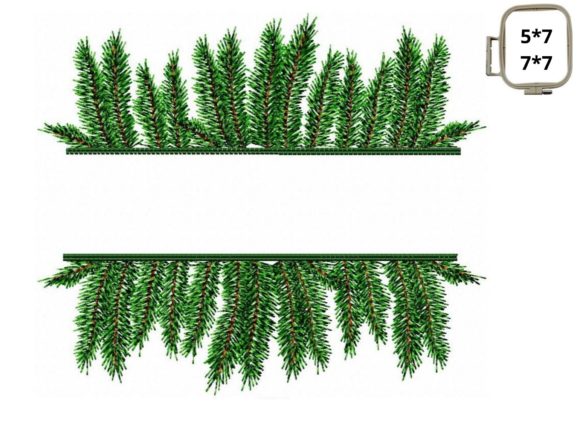
When a new embroidery design file lands in my library, my first question isn't about its beauty, but about its business potential. The Fir Branch Border arrives with a clear proposition: a Christmas-themed border design perfect for home goods. But for an embroidery designer working with small businesses, the real review starts when we consider it as an asset for branded merchandise, patches, and commercial apparel.
First Impressions: Visual Personality & Brand Alignment
The immediate feeling from the Fir Branch Border is classic and rustic with a touch of elegance. It doesn’t scream "holiday" in a cartoonish way, which is a significant advantage for business use. This subtlety means it can evoke a cozy, natural, and premium feel—qualities that align beautifully with brands like a local bakery, a handmade candle shop, a boutique café, or a creative florist. It feels handmade without being crude, and professional without being cold. This is a crucial balance for businesses that want to project authenticity and quality.
The Real-World Business Use: From Patches to Product Labels
Let’s move past kitchen towels and imagine real scenarios for a small business owner or merch creator.
Embroidered Patches for Brand Identity
An embroidered patch is a versatile branding tool. The Fir Branch Border could be excellent as a standalone patch for a tote bag, or as an accent border around a company’s main logo patch. For a pet brand or a local outdoor shop, this natural branch motif reinforces a connection to nature. As a sleeve detail on staff uniforms, it adds a distinctive, branded touch without overpowering the primary logo. Its continuous border nature means it can frame text or a central image effectively, creating a cohesive, finished look for a custom apparel item.
Uniform & Workwear Enhancement
For staff aprons in a café or bakery, a chest or pocket accent using this design adds a festive yet professional touch during the holiday season, enhancing customer recognition. On a work shirt for a boutique or a creative studio, a smaller version along a collar or placket can serve as a subtle brand mark. It’s about using embroidery to build a consistent visual identity across all touchpoints.
Merchandise & Customer Gift Value
Tote bags, lunch mats, or even branded tea towels become elevated small business merch with this design. It turns a functional item into a desirable, giftable product. For an Etsy seller or a handmade brand, incorporating such a design onto their product packaging or as a sewn-in label accent can significantly increase the perceived value and handmade presentation of the finished product.
Practical Considerations for Production Success
Your excitement for a design must be tempered with production reality. Here are my professional embroidery designer notes for using the Fir Branch Border in commercial projects.
Testing is Non-Negotiable
Always stitch out a test first. I recommend doing it in a single, neutral thread color (like black or dark green) on your target fabric to check clarity and integrity. This reveals any potential issues with small connecting lines or density before you commit thread colors.
Size & Placement Challenges
As a border, its linear nature means careful consideration for curved surfaces or very small areas. On a cap front, for instance, you must check if the design’s intended length fits the curved space without distortion. For a very small embroidered patch (under 2 inches), the detail of the fir branches might need simplification—you must test it at the reduced size to ensure the design remains crisp and recognizable.
Fabric & Stabilizer Foundation
The success of any machine embroidery design hinges on the right stabilizer and understanding fabric texture. For tote bags (often made of canvas), you’ll need a sturdy stabilizer to handle the thicker material. On a smooth apron twill, a lighter stabilizer may suffice. The design’s stitch density, which I would advise you to check in the provided files, will dictate this choice. Frequent washing, as with uniforms, demands high-quality thread and a robust stitch structure to ensure longevity.
Color Strategy for Contrast & Branding
Don’t just use default greens. Think about your brand colors and thread color contrast. On dark uniforms, consider using a brighter, contrasting thread palette for the Fir Branch Border to ensure visibility. For a more subdued, elegant look on light fabrics, a monochromatic scheme using different shades of one color can be stunning.
Licensing & Professional Process for Business
A final, critical step for any business use is confirming the commercial licensing terms of the digital embroidery file. The description notes it comes with multiple embroidery file formats, which is excellent for using different machines. However, before running production on staff uniforms or merchandise for sale, you must explicitly verify that your intended commercial use is covered by the license. This is a standard professional practice to protect your business.
Furthermore, always create a printable mockup for client approval. Showing a business owner how the Fir Branch Border will look on their specific apron or tote bag mockup avoids misunderstandings and ensures the design assets align with their brand identity. Compare it beside their other logos or graphics to guarantee visual consistency.
The Bottom Line for Your Brand
The Fir Branch Border transcends its initial description as a decorative Christmas border. For a small business, it becomes a tool for building brand identity, enhancing customer trust through professional presentation, and increasing the value of your merchandise. Its rustic elegance can make a staff uniform feel special and a product feel premium. By approaching it with a professional’s eye—testing thoroughly, considering size and fabric, and verifying licensing—you transform a simple embroidery file into a reliable, effective asset for your commercial embroidery projects and branded storytelling.